Fallout Season 2, Episode 5, “The Wrangler” Recap & Review

WARNING: SPOILERS AHEAD
Here we are, more than halfway through Fallout Season Two. In this episode, titled “The Wrangler” the tone stays wry and cinematic, but the momentum feels more like “getting to the good stuff” than actually hitting the jackpot, landing the episode at a solid-but-not-transcendent 8.5 in terms of payoff.
The episode throws us right back where the last episode ended... Lucy and Coop with the deathclaws, and Cooper Howard having only one answer: run. The presence of three deathclaws raises the stakes in this scene; it finally lets the show linger on something Cooper rarely shows... actual fear. However, this scene is short and fleeting as Lucy and Coop escape shortly thereafter.
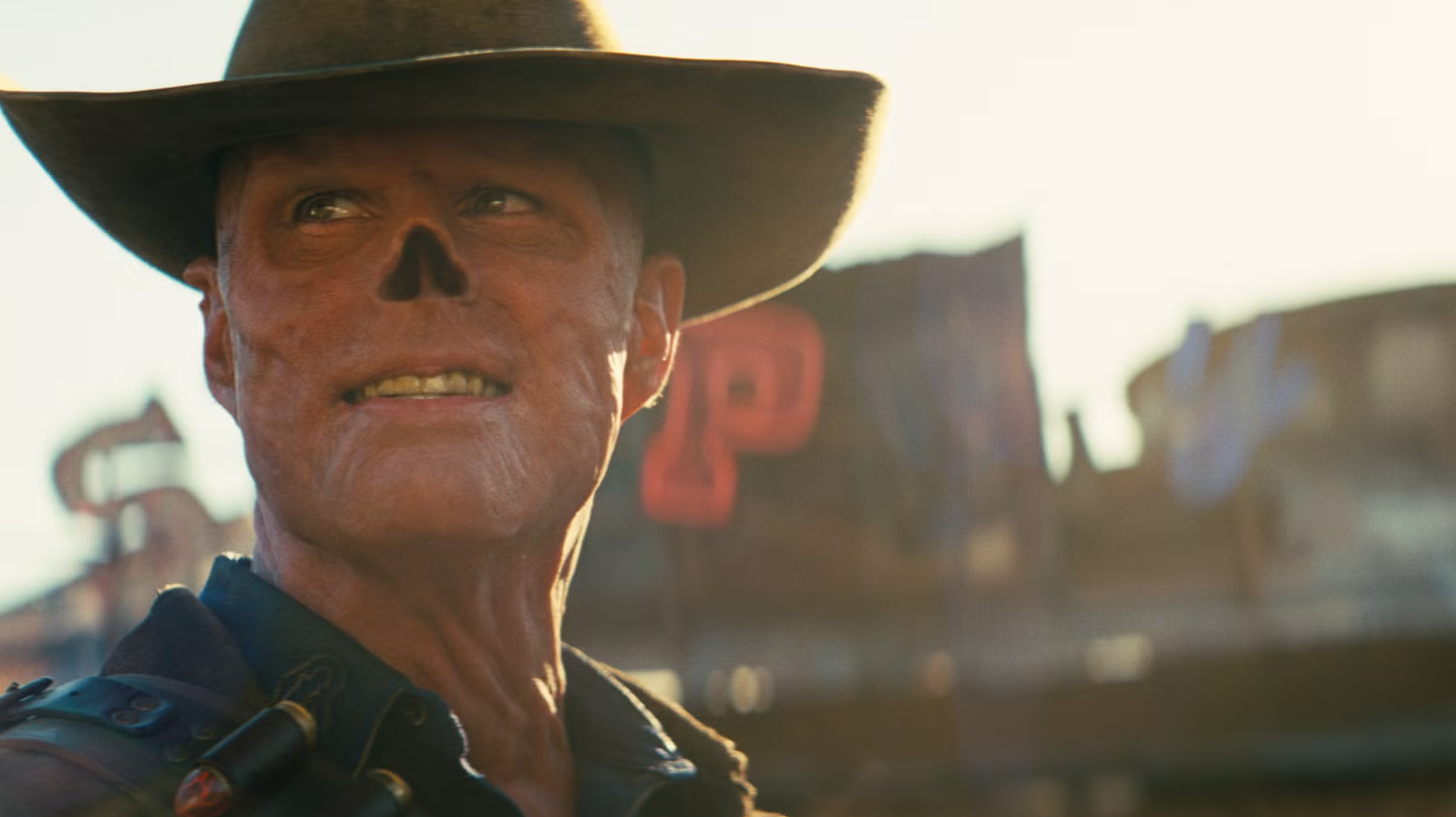
When they make it out and the episode cuts to the Vegas Strip in what feels like “the morning after,” the tonal whiplash is intentional. The New Vegas of this episode is noticeably more alive than last episode, with people actually out on the streets. The detail that the Vault-Tec building, surrounded by deathclaws, may hold pods for senior management (and therefore Coop’s wife and daughter) finally crystallizes why Cooper is still riding shotgun with Lucy.
Cooper sending Lucy off to go get drugs so he can go “get fucked up” is interesting. The ghoul, as the unwilling father figure, outsources emotional labor while he tries to drown his own ghosts in whiskey. His conversation with the bartender, especially the bit where he shuts him down and retreats into his reflection, plays like a man trying not to look too closely at the monster he’s become. The way he stares in the glass shows us that he’s rattled not just by deathclaws, but by what they represent for him, his past, and most likely his future.
The flashback chain that follows, triggered by a Robert House TV ad, shifts the episode back into corporate noir. Cooper is still technically on assignment to assassinate House, taking poison from Lee Moldaver with a line that might as well be printed on Vault-Tec letterhead: “In this case, the ends justify the means.” His dry comeback lands like the moment he quietly refuses to be another cog in their morally outsourced machinery. He won’t kill House, but he’ll still help Lee, and that moral half-measure sets up the episode’s real tension: Cooper is always trying to split the difference between survival and conscience.
New Vegas in its pre-war prime gives the show an excuse to flex. Neon, spectacle, and a big “Welcome to the defense contractors’ summit brought to you by ROBCO” sign hammer home how House’s city has always been a casino built on warfare. Cooper and his wife arrive at the Vault-Tec Hotel just in time to cross paths with Dianne, the congresswoman protesting corporate takeover of the government from episode 3, and Cooper’s casual “keep at it!” is a tiny, telling beat: he is sympathetic, but still walking back inside the machine.
Cooper spots Hank with a special accessory: a briefcase handcuffed to his wrist. Before we can dwell too long at that, we get a slow-motion elevator sequence. The henchman’s gaze burning into the back of Cooper’s head are all shot like a mob thriller, showing that Coop is marked long before he realizes it. When the elevator doors open onto who we assume is Victor (the automaton from earlier this season) and “Robert House,” the bathroom meeting finally clicks into place for cooper; “From the fucking toilet?” he exclaims, and the episode leans into House’s brand of omniscient tech horror. House’s reveal that the man in front of Cooper is just a paid actor who has been playing him for a decade sharpens the show’s favorite theme: in Fallout, the face of power is often just that—a face.
House talking about seeing the “demon in the snow” through Cooper’s power armor tech reframes that deathclaw encounter as surveillance as much as horror. His claim, “What I do is I know everything,” casts him as an all-seeing eye who has extended his cameras from the Strip out to the battlefield. He dates the end of the world to April 14, 2065, at 5:17 a.m., which also happens to be Cooper’s daughter’s birthday, is this episode’s most intriguing sequence. The play of power and knowledge, the tug between science and fiction... many things were at war and not just Cooper and his conscious.
The kicker is House’s theory that the same force behind the “demons in the snow” will also end the world, and that Cooper is somehow the unknown variable that shifted the apocalypse timeline forward the day he bought his ticket to Vegas. House framing himself as “the house” in the metaphor—while also wondering if someone else is actually running the game—is deliciously ironic, especially in a city where the house is supposed to always win. Cooper calling him a lunatic and bolting out of the office with what looks like a full-blown anxiety attack undercuts the myth of the cool, unflappable Cooper Howard; in that moment, he is just a man being told the universe bends around him and desperately wishing it didn’t.
Parallel to the Vegas glam, Hank’s storyline drags the episode back into some season one roots. The snake-oil merchant from season one rolls into town with a briefcase that likely contains the fusion core he conned out of Thaddeus, a neat bit of continuity that ties the man’s old grift to the current stakes. Hank knocking him out in a bar and waking him up with a device latched to the back of his neck harks back to episode 2 of this season, and feels like classic Vault-Tec experimentation rebranded as “innovation.”
The merchant’s broken “please, yes” when Hank offers to erase his memories sells how easily desperate people sign away their minds in this world. The way Hank beams when he hits the red button, proud of having “fixed” the device, is more unsettling than any gore would be; it suggests he is past the stage of questioning whether he should and firmly in the phase of perfecting how he can. The pan to the cryo pods labeled “BARBRA HOWARD” and “JANEY HOWARD” twists the knife further: Cooper’s family is here, frozen in the middle of Vault-Tec’s ongoing science fair, and this city of casinos and corporate shows is also a mausoleum of suspended lives.
Back with Norm and the Vault 31 crew, the show continues its habit of turning corporate offices into haunted houses. Fresh blood on the walls, strange noises, and the offhand “I need to craft a weapon” line make the scene feel right out of a Fallout game. When Ma June and her companion Barb emerge with guns raised, the narrative stitches season one and two together even more, rewarding anyone who remembers Ma June’s “fuck the Vaults” energy and middle finger to Lucy.
Ma June recognizing “more vault dwellers” puts Norm on high alert, especially once she drops that she met his sister in Philly and that she’s probably dead. Her attempt at being kinder (snapping at Barb to “shut the fuck up, I’m trying to be a good person”) is both darkly funny and quietly heartbreaking; this is a woman who’s seen enough Vault-Tec fallout to be done with their ideals, but not enough to stop trying, badly, to help the kids who keep stumbling out of those holes. Norm comforting a crying teammate who only started her job “a week ago”, and digging through Barbra Howard’s computer once he hears her name, keeps his thread grounded: this is the slow, bureaucratic detective work that fills in the edges of the larger narrative conspiracy.
Lucy’s errand is quickly turned into a microcosm of her moral crumbling. She is stealing drugs and a power fist (an iconic bit of Fallout kit that turns a punch into a powered gut-shot), and that already marks her pivot from idealistic Vault girl to someone willing to bend rules. Getting caught sneaking in only to realize the “owner” is dead and the man confronting her is actually robbing the place turns the scene into a twisted standoff of two people trying to survive ugliness in their own way... When Lucy shoots him and kills him, the surprise on her face hits hard. This, with the additional sprinkle of the arrival of a girl asking “Who are you?” followed by Lucy’s dazed “I don’t know,” is pretty much the thesis statement for her whole arc this season. Between drug addiction, murder, and the wasteland’s relentless erosion of Vault morality, she is no longer the person she thought she was, and the show finally lets her say it out loud.
This feels like a “getting there” episode: all set-up. Norm’s scenes do a good job of feeding additional context into the veins of the other storylines without feeling like lore dumps, and the Robert House material definitely raises a lot more questions. The different storylines between present Vegas, pre-war Vegas, Vault 31 trek, and Hank’s experiments build a sense of a world primed to explode.... and I am READY for it.
But with only three episodes left, the hour can’t fully escape the sense that it is more “ramping up” than detonating. So much narrative and character progression happens... Cooper’s connection to the apocalypse, confirmation his family is in New Vegas, Lucy’s identity crisis, Hank’s improved device working, Norm’s new lead... that almost every plotline feels like it ends just before the really wild part. This episode is a pretty solid lore-rich entry, but feels more like the last big shuffle before the poop really hits the fan. I am giving this episode an 8 out of 10... Not a bust by any means, but not quite the all-in, chips-on-the-table high that episode 4 managed to hit.