Fallout Season 2, Episode 4, "The Demon In The Snow" Recap & Review

WARNING: SPOILERS AHEAD
Season 2, episode 4 of Fallout opens as a war film dropped into a fever dream... Smoke rising against frostbitten skies, bullets cracking the air, and Cooper Howard (Walton Goggins) emerging in his power suit under the eerie glow of the Alaskan front. This mid-war flashback is staged like a scene out of Apocalypse Now, only MUCH colder, darker, and lonelier. The direction feels a bit more cinematic this time, leaning into visual storytelling rather than dialogue. The cinematography uses a lot of dark muted blues and harsh shadows, contrasting the mechanical grind of power armour malfunctioning against the sounds of the battlefield. It’s beautiful and terrifying all at once... a perfect example of the show’s knack for industrial horror.
When Cooper sends Chuck (who we know from the previous episode) back to base, the camera lingers just long enough on Cooper’s face to reveal doubt creeping beneath his soldier’s discipline. There are sounds in this scene carrying the weight, with distant howls, falling trees, and the thread of a snowstorm blowing through. This is the reveal of the “Demon in the Snow,” a minotaur-like beast that moves, who Fallout game fans will know is a deathclaw (genetically engineered reptilian creatures), and then we get a close-up of his evaluation of Coop before getting distracted and walking off. Fallout has always thrived on moral monsters, but here, we get something right out of a fantasy novel. In relation to Cooper and who he is as a character, it’s almost like the creature feels like an external reflection of Cooper’s guilt... his fear of what kind of man he is and does become. Since the monster didn’t kill him, it was almost a verification of “I wont kill him, he's like me”.
From that chaos to Maximus (Aaron Moten) and Thaddeus (Johnny Pemberton), the tonal shift is jarring but intentional. Their scenes play out like a buddy comedy coated in a panic attack. Max’s guilt over killing Zander hangs heavy, and his desperate ploy—to disguise Thaddeus as Zander from the commonwealth who was killed last episode—is such a distinctly Fallout kind of comedy: ludicrous and tragic at the same time. The editing is crisp here, cutting from tension to levity in a beat that mirrors video game pacing... Chaos, calm, dialogue wheel, chaos again. The sound work deserves credit too, especially the orchestral cues that swell during their flight back to base. Fallout’s soundtrack continues to pair vintage warmth with dread, balancing nostalgia and doom in a way that keeps the world alive without overplaying its hand.
Meanwhile, Lucy (Ella Purnell) and Coop find themselves trudging through what remains of New Vegas. Their dynamic remains the show’s central anchor. As we’ve discussed for previous episodes, she represents the naive moral clarity of Vault life; he’s the wasteland’s permanent shrug. The dialogue between them in this episode hits tighter rhythms. There is a lot less exposition and a lot more subtext. The scene where Coop diagnoses her withdrawal from Buffout (or what they call “buff” on the show) plays like a darkly funny intervention staged somewhere between trainspotting and a western standoff. Lucy’s horror at discovering her chem addiction mirrors Fallout’s broader thesis: that purity is a myth, especially when survival demands compromise.
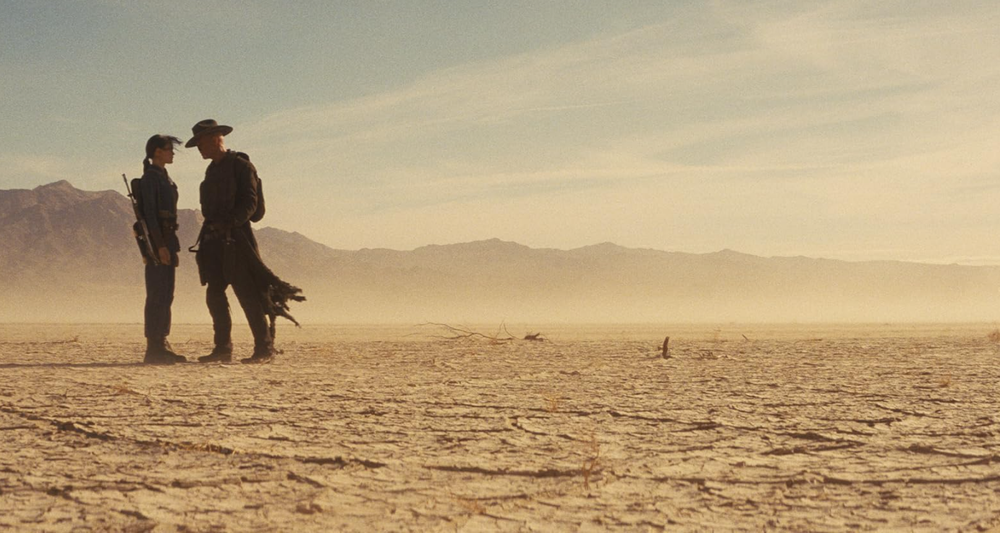
Visually, their trek through the desert is stunning as always. The cinematography adopts warmer hues like burnt oranges and deep copper tones that starkly contrast with the Alaskan Front’s cold open. It can be seen as the very stark contrast between Cooper's life before, during, and after the bombs as well. It’s also where we start to see director-level attention to mise-en-scène. The “Las Vegas City Limits” sign does powerful narrative work of showing us a city that never stopped gambling, even when the stakes became survival itself.
Back in Vault 33, the narrative slows down to study control and scarcity. This series does a good job balancing the big picture and the small moments that will still affect the larger story (or so we hope) at a later time. The “snack club” subplot might sound goofy on paper, but it’s actually a smart exploration of how comfort is politicized when resources dry up. The tension between Reg (Rodrigo Luzzi) and Overseer Betty (Leslie Uggams) is framed with tighter and tighter shots, starting with wide shots and getting closer and closer as the tension between the two characters rises. These symmetrical shots emphasize bureaucracy gone claustrophobic. Something that we see in movies like Dr. Strangelove, showing a sense of comedy about systems too rigid to adapt. Getting this view of Betty fighting to save her people, and Reg completely not thinking long-term, is fun to watch.
Vault 31’s thread, led by Norm (Moises Arias), continues to develop nicely. The official introduction of Ronnie McCurtry adds a corporate layer to Fallout’s brand of social horror. The writing here sharpens its satire again... short, punchy dialogue that plays as dark PR slogans reworked into survival tactics. Another battle for power as Ronnie not-so-subtly threatens Norm.
Back with Lucy, her drug withdrawal meltdown in New Vegas is probably my favourite part of the episode. The direction turns comedically cinematic. Watching her gun down a pack of ghoulish Elvis impersonators plays both as horror and tragic farce, complete with exaggerated framing, and a score that feels lifted from a spaghetti western. The editing is playful and quick, making every gun blast feel instinctive rather than heroic. This sequence really works because it’s the moment Lucy fully cracks... Be it from the drugs or not. Not because she’s losing control, but because the wasteland finally forces her to stop pretending she has any to begin with. While Cooper doesn’t have much dialogue in this scene, his subtle reactions to her chaos are very delightful. It feels like this is the moment where they really start to bond.
And then there’s Max. His confrontation with Quintus (Michael Cristofer) is one of the season's better performances for Max. The writing gets sharp here too, with Quintus declaring, “Kill me, and the world will continue just the way you see it... I will bring order.” The line leans on a well-established biblical rhythm, echoing how Quintus’ Brotherhood continues its obsession with turning technology into theology. The tension peaks through editing that rapidly crosscuts between Max, Thaddeus and Dane, expanding like a balloon until it pops... Followed by MANY gun pops as well.
Back to the heart of Vegas at night, Fallout reverts beautifully to its horror roots. Coop’s realization that New Vegas is empty builds unease through silence. The pacing here is masterful—eerily quiet for a “city”, barely a low hum of wind, wide shot pulling back to reveal a still city that shouldn’t be still. The reveal of the deathclaw acting as a kind of narrative callback seals the metaphor. Humanity’s sins are finally crawling out from under the concrete.
The episode ends with Lucy’s terrified face. It’s a bold way to close an episode that’s already teetered between introspection and spectacle. In my opinion episode 4 is the strongest of the season so far. The directing feels deliberate, the cinematography expressive, and the soundscape immersive without being intrusive. What keeps Fallout from absolute greatness, though, is its balancing act of storylines. It still juggles too many stories that feel alive on their own but compete for space when placed side by side. I feel myself wanting more from each arc, which is hard to fit into a single episode.
Episode 4 is near perfect, it confidently finds the show’s cinematic rhythm... Half war movie, half comedy of errors, with just enough heart to remind us why Fallout’s world, for all its monsters and ghouls, still feels very human.